

Luxury has always been synonymous with rarity, but the definition of rarity is shifting. For the modern connoisseur, actual value no longer lies solely in the scarcity of a stone but in the integrity of its origin and the brilliance of its cut. High-end fashion has welcomed a significant player that challenges old norms while delivering identical chemical and visual properties to mined counterparts. We are discussing the rise of stones created above ground, a choice that aligns with the values of a generation prioritising sustainability without compromising on glamour.
Before investing in your next statement piece, you might have questions. Are these gems authentic? Do they offer the same sparkle? The short answer is yes. They are chemically, physically, and optically identical to those mined from the earth. The only difference is their origin. This guide serves the fashion-forward individual who seeks to understand the nuances of these stones, ensuring your subsequent acquisition is as smart as it is stunning.
The Shift in High-End Jewellery
Fashion dictates that style should never come at the expense of conscience. High-jewellery houses and independent designers alike are turning their attention to created stones to offer clients a guilt-free alternative. A demand for transparency drives this movement. When you wear a piece of jewellery, you want to know its story. Stones created in controlled environments offer a traceable history that mined stones often lack.
This transition does not mean a sacrifice in quality. On the contrary, the controlled conditions allow for the creation of stones with fewer impurities. You can acquire a gem of superior colour and clarity for a price that reflects the stone itself, rather than the high logistical costs of mining. It is a pragmatic approach to luxury that appeals to those who understand value.
Understanding the Science of Sparkle
To appreciate these gems, one must understand how they come to be. Scientists replicate the natural conditions on Earth, intense heat and pressure, to crystallise carbon into a diamond. This process, known as High Pressure High Temperature (HPHT) or Chemical Vapour Deposition (CVD), results in a rough stone that is cut and polished exactly like a mined one.
Distinguishing between the two without specialised equipment is impossible. They have the same refractive index and dispersion, meaning they handle light identically. If you place them side by side, the fire and brilliance are indistinguishable. The appeal lies in the fact that you are purchasing an innovative product. It is a celebration of human achievement alongside natural beauty.
Sourcing Your Jewellery
Finding the right retailer is as important as choosing the right stone. You want a jeweller who offers a curated selection and transparent advice. Many high-street and online retailers now feature extensive collections of lab-grown diamonds, allowing you to compare loose stones or finished pieces with ease. Look for retailers who provide high-resolution imaging and detailed grading reports so you can inspect the stone’s quality before making a decision.
What to Look for Before You Buy
When selecting a stone for a ring, necklace, or pair of earrings, the criteria remain stringent. The “4Cs” Cut, Colour, Clarity, and Carat are the universal standard, and they apply just as rigorously here.
Prioritising the Cut
The cut is the most critical factor. It determines how the stone interacts with light. A well-cut stone will reflect light internally and disperse it through the top, creating that signature sparkle. If the cut is too shallow or too deep, light escapes, leaving the stone looking dull. For a luxurious appearance, insist on an “Ideal” or “Excellent” cut grade. This ensures maximum brilliance and fire, making the stone the focal point of any ensemble.
Assessing Colour and Clarity
Colour is graded on a scale from D (colourless) to Z (light yellow). In the luxury sector, you should aim for the colourless range (D-F). These stones appear icy white and offer the most versatile look for setting in platinum or white gold.
Clarity refers to the absence of internal inclusions or external blemishes. While created stones can have inclusions, it is easier to find high-clarity grades like VVS1 or VVS2 (Very Very Slightly Included) at a more accessible price point than with mined options. These imperfections are invisible to the naked eye, ensuring your jewellery looks flawless to admirers.
Carat Weight and Visual Impact
Carat refers to the weight of the stone, not its size, though the two are correlated. Because of the price advantage, you can choose a larger carat weight without stretching your budget. A 2-carat solitaire that might have been out of reach with a mined stone becomes a tangible reality. However, never sacrifice cut quality for size. A smaller, brilliant stone will always look more luxurious than a large, dull one.
The Role of Certification
Never purchase high-value jewellery without proper documentation. Reputable gemological laboratories, such as the IGI (International Gemological Institute) or the GIA (Gemological Institute of America), grade these stones just as they grade mined stones. A report from these institutions confirms the stone’s identity and quality grades. It provides peace of mind and verification that you are getting precisely what you paid for.
Integrating Modern Gems into Your Wardrobe
The versatility of these stones makes them suitable for every occasion, from red-carpet events to intimate dinners.
Statement Rings
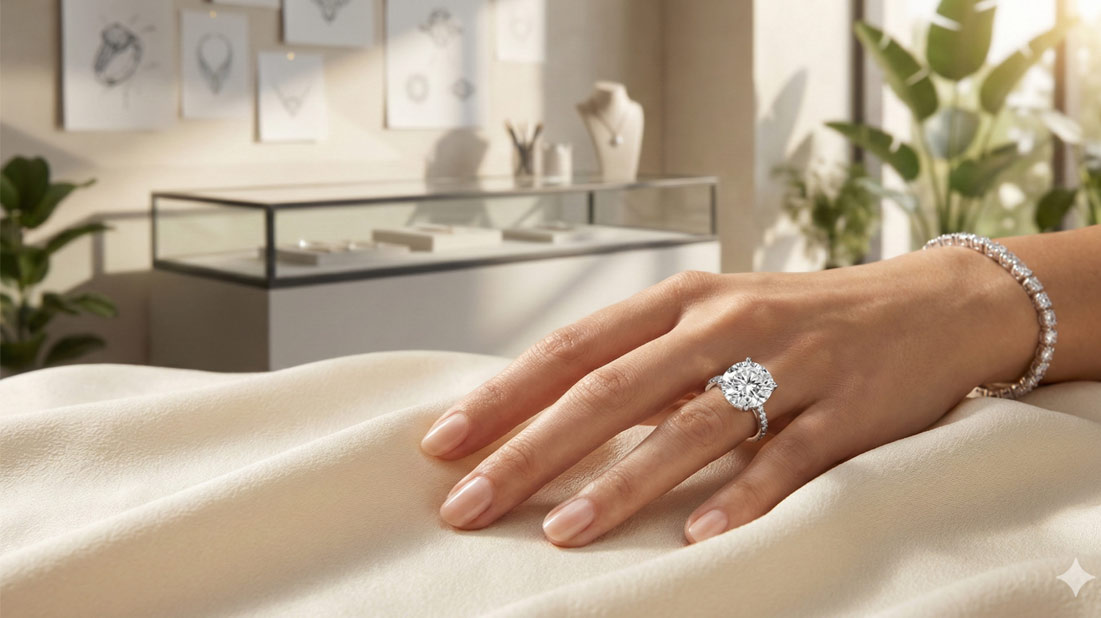
An engagement ring is the most common application, but cocktail rings are making a resurgence. A large, emerald-cut stone set in a minimal band creates a modern, architectural look. The stone’s clarity takes centre stage, offering a sleek aesthetic that complements contemporary fashion.
Earrings and Necklaces
For earrings, solitaire studs are a timeless staple. The superior colour grades available with created stones mean these studs will significantly brighten the face. Tennis necklaces are another area where these gems shine. The consistency in cut and colour achievable in a lab ensures a uniform line of brilliance around the neck, a feat that is often difficult and costly to achieve with mined stones.
The Ethical and Environmental Advantage
For the eco-conscious elite, the environmental footprint is a primary consideration. Mining shifts massive amounts of earth and requires significant water and energy. Created stones significantly reduce this physical disruption. While they do require energy to produce, many producers are moving towards renewable energy sources to power their facilities. This commitment to reducing impact resonates with those who view luxury as a responsibility as well as a privilege.
Moreover, the human cost is minimised. Created stones are free from the conflict and exploitation that have historically plagued the diamond industry. Knowing your jewellery is conflict-free adds an intangible layer of value. It allows you to wear your pieces with pride, knowing they represent a cleaner, fairer industry.
Investment Value vs. Emotional Value
A common query concerns the resale value. Indeed, created stones do not hold the same resale value as rare, large mined stones might. However, jewellery should primarily be viewed as an emotional investment rather than a financial one. The “smart money” perspective focuses on the initial savings. By paying significantly less upfront, you retain capital to invest elsewhere while still enjoying a luxury product. The value lies in the enjoyment, the style, and the ethical stance the piece represents.
Final Thoughts
The landscape of luxury is changing. It is becoming more inclusive, more transparent, and more intelligent. Choosing a created stone is no longer a compromise; it is a calculated decision to prioritise quality, ethics, and style. As you curate your collection, remember that the most beautiful accessory is one that aligns with your values. Whether you are searching for the perfect engagement ring or a pair of earrings to complete a gala look, these stones offer a brilliance that rivals the stars, grounded in a process that respects the earth.