

Recently, I have noticed something unique about clinicians’ patterns in using EHR. They spend hours documenting and manually moving information from one system to another. Completely moving away from the purpose of adopting an EHR.
And this is not a story of only a single clinic, as many of our clients face the same issues. So, I decided to connect the dots, and that’s when I noticed a pattern. Many clinics that use generic or off-the-shelf EHRs have these same challenges.
But why does this happen?
Well, the answer is rigid workflows, one-size-fits-all templates, and very little room for customization. Today, where clinics demand flexibility, speed, and efficiency, this becomes a major bottleneck. With a generic EHR, clinicians spend half the encounter navigating the screens, rather than connecting with patients.
One of our clients put it perfectly, ‘We don’t just need a data entry system, we need a system that adapts to how we work and makes work easier.’
This made something crystal clear to me — customizable EHRs are no longer optional. They are essential for modern clinics. These systems give practices the freedom to tailor workflows, customize templates, and scale their EHR as they grow.
A customizable EHR doesn’t just enhance documentation; it transforms how the entire clinic operates.
So, in this post, we will explore why customizable EHRs are crucial, how they benefit clinicians, and which features make custom EHR software truly efficient.
Why Traditional EHRs Fail Modern Clinics
By reading the introduction, you might have understood that a generic EHR fails modern clinics because it is too generic. At first glance, it may seem affordable, and it may seem great that you have a system that works for everything.
But over time, clinics discover the opposite. These systems have a bit of everything and a lot of nothing. For example, a primary care clinic ends up with unnecessary surgery features, leading to cluttered interfaces and extra clicks.
Most importantly:
- They force every clinic, specialty, and provider into the same rigid workflows.
- Clinicians are left clicking through irrelevant screens.
- Staff start finding workarounds to complete simple tasks.
A behavioural health clinic, for instance, may be forced to use templates meant for orthopaedic exams — completely misaligned with real clinical needs.
Traditional EHRs also struggle with interoperability. They allow basic data import, but when it comes to smooth data flow, they fall short. The result? Duplicate documentation, half-complete patient charts, and a constant chase for missing information.
When you combine all of this, the EHR becomes a barrier rather than a support. Providers burn out, productivity drops, and clinics lose revenue due to coding errors and denials.
In short, what seems affordable becomes a silent drain on efficiency, money, and clinician well-being.
Why a Customizable EHR is the Right Solution for Modern Clinics
If a generic EHR makes processes inefficient, causes burnout, and creates workflow friction, then customizable EHRs are the complete opposite. They do not force you to adopt; they are built to adapt to how you work. And this is why modern clinics are turning towards customizable EHR to streamline workflows.
A big advantage of custom EHR software is that it doesn’t just add features— it reshapes the entire clinical experience. Here is what makes customizable systems the right solution for modern clinics:
- Custom Workflows: Every clinic works differently, and this means their workflows are also different. This is where a customizable EHR allows you to tailor your workflows to match your practice-specific needs. You can customize processes from patient intake to how physicians document.
- Specialty-Specific Templates & Forms: Unlike a generic EHR, a custom EHR builds templates to match your specialty. You don’t have to go through unnecessary fields and extra screens that you don’t require. For example, cardiology practice templates with only demographic fields, history, vitals, and procedure fields, without any fields mixed in for oncology.
- Better Interoperability: This is where a custom EHR truly becomes a total advantage by seamlessly connecting billing, labs, pharmacy, and provider systems with custom HL7/FHIR-based connections. You can automatically sync lab reports, medications, and billing, leading to accurate and complete documentation, easily achieving seamless data exchange.
- Support for Modern Care Models: Right now, clinical care is not just limited to the hospital. It has become digital and team-based care. Customizable EHRs easily support all the telehealth workflows, RPM devices, and care coordination tools needed to deliver this digital care.
- Scalability: One of the best things about the customizable EHR system is that you can easily add new systems, modules, features, and adjust to higher patient volume without breaking the workflows. You don’t have to overhaul entire systems every time a technology evolves or a new regulation comes in.
So, a customizable EHR eliminates all the inefficiencies of generic EHRs by tailoring workflows and templates, making every step intuitive.
Key Features of the Customizable EHR
Before you build a custom EHR system, you need to understand how efficient an EHR system is based on its features. That’s why you need essential features to make the custom EHR efficient. Here are those key features for building the right modern clinic EHR:
- Configurable Templates & Forms: Clinics should be able to build and modify templates based on visit type, specialty, and provider preference. Custom fields, smart forms, dynamic checklists, and specialty-specific assessments help reduce documentation time and improve accuracy.
- Flexible Workflow Builder: A truly customizable EHR lets clinics design workflows that match their processes. Everything from intake and triage to documentation, billing, and follow-ups. This includes rule-based automation, branching logic, alerts, and reminders tailored to clinical requirements.
- Role-Based Dashboards & Views: All clinical staff, whether it is doctors, nurses, billers, or front-desk teams, all work differently. This is where role-based dashboards help each user see the tasks, data, and tools relevant to their work, improving usability and reducing unnecessary clicks.
- Advanced Interoperability & APIs: Custom HL7/FHIR integrations, API access, and seamless syncing with labs, imaging, pharmacies, and billing systems ensure clean data flow. This eliminates double work and supports coordinated care.
- Scalability & Modular Architecture: As clinics expand services or locations, the EHR should easily support new modules, specialties, workflows, and reporting needs without major redevelopment.
- Compliance & Security Controls: HIPAA-compliant access controls, audit logs, encryption, and permission customization help clinics stay secure while maintaining smooth operations.
These are the key features that make an EHR truly adaptable and ready for modern clinical demands. So, when you are trying to build an EHR system, always pay attention to adding these features.
Benefits of a Customizable EHR
A customizable EHR is not limited to just streamlining documentation — it completely reshapes how your clinical operates. When your system aligns with your workflows, care is streamlined, patient experience becomes smooth, and staff are more satisfied. Here are the clinical and operational EHR customization benefits:
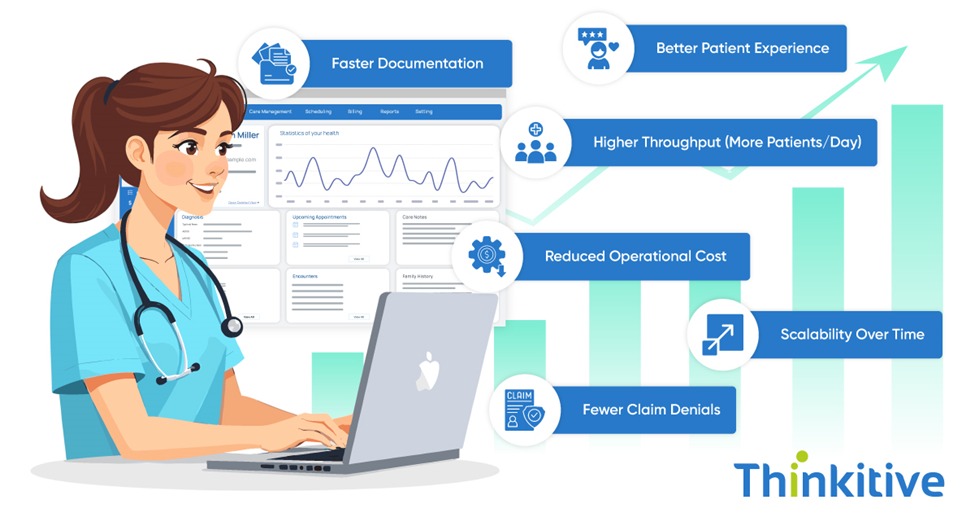
- Faster & Cleaner Documentation: Custom templates make documentation faster by reducing unnecessary fields and clicks. This also reduces errors and makes it easier to capture relevant patient details in each patient encounter.
- Smoother Care Coordination: When workflows and data fields match the way each team works, information flows naturally across nurses, physicians, administrative staff, and billing. This reduces miscommunication and improves continuity of care, especially in multi-provider or multi-specialty clinics.
- Reduced Provider Burnout: Customization also reduces work for providers. With customized dashboards, intuitive navigation, and automated tasks, you can easily eliminate repetitive steps that drain mental energy. More face time with patients and less time wrestling with the EHR means happier and lower exhaustion.
- Higher Billing Accuracy & Fewer Claim Errors: With custom workflows and integrated billing logic, clinics capture complete documentation, code visits correctly, and reduce rework. This leads to faster reimbursement and fewer denials, making the revenue cycle efficient.
- Better Patient Experience & Outcomes: When providers can quickly access relevant information, document accurately, and give patients their full attention, they improve care quality. This leads to a rise in patient engagement, follow-ups become smoother, and patients feel more supported.
Cost & ROI Outlook for Clinics
While customizable EHR transforms clinical workflows, it also brings significant improvements in the financial health of the clinic. A flexible EHR reduces operational inefficiencies, improves billing accuracy, and almost eliminates denials. Moreover, automation reduces wasted hours, making a customizable EHR one of the best investments a modern clinic can make.
Here is how it benefits a clinic in the long and short term:
| ROI Area | Short-Term Impact | Long-Term Value |
| Operational Efficiency | Reduced manual data entry; fewer workarounds | Streamlined workflows that save staff hours daily |
| Staff Productivity | Faster onboarding with role-based views | Sustained reduction in burnout and turnover |
| Billing & Revenue Cycle | More accurate coding and fewer claim errors | Faster reimbursements and higher revenue capture |
| Automation Gains | Immediate time savings from automated tasks | Significant reduction in wasted clinical time each year |
| Interoperability | Less duplicate documentation | Lower admin overhead and cleaner data across systems |
| Scalability | Ability to add templates or forms quickly | Supports new services (RPM, CCM, BH) without new systems |
Conclusion
As the healthcare tech is evolving and modern clinics are growing, generic EHRs are not enough. With their rigid workflows, one-size-fits-all templates, and lack of interoperability, these systems make delivering care and managing patient data difficult. That’s why most of the modern clinics are turning towards customizable EHRs.
With these EHRs, you can easily tailor workflows to match your processes and connect systems from labs, billing, and pharmacy systems. Moreover, with features such as AI-driven personalization, predictive analytics, and voice-enabled documentation, care is both accurate and convenient.
So, if you are struggling with your generic EHR, then it is time to switch to a more efficient and customizable EHR that works for you.
Click here to connect with our team and get a free assessment to see how a customizable EHR can transform your clinic.
Frequently Asked Questions
- What is the difference between a standard EHR and a customizable EHR?
A standard EHR comes with fixed templates, predefined workflows, and limited flexibility. Clinics must adapt their processes to how the system works. A customizable EHR, on the other hand, adapts to the clinic. It allows custom templates, specialty-specific forms, personalized workflows, role-based dashboards, and flexible integrations. Instead of forcing all providers into a one-size-fits-all system, it supports the way each clinic actually operates.
- Does a customizable EHR improve clinic workflow efficiency?
Yes, customizable EHRs significantly improve workflow efficiency because they remove unnecessary steps and align with how staff already work. Providers document faster using personalized templates, admin teams avoid double data entry, and automated rules reduce repetitive tasks. The result is smoother coordination, fewer bottlenecks, and more time for patient care.
- Is a customizable EHR suitable for small clinical practices?
Absolutely, small clinics often experience the biggest gains because they don’t have the resources to waste time on rigid, inefficient systems. A customizable EHR lets them streamline documentation, improve billing accuracy, and scale as they grow — without needing enterprise-level infrastructure. Many customizable EHRs start small and expand only when the clinic needs more modules.
- How much customization does an EHR typically allow?
Customization varies by vendor, but modern customizable EHRs generally offer:
- Configurable templates and forms
- Custom workflows and branching logic
- Role-based dashboards
- Custom data fields and flowsheets
- Flexible reporting and analytics
- API-based integrations with labs, billing, and devices
- Some systems support deep, almost full customization, while others limit changes to basic templates. The key is choosing a system that matches your clinical and operational needs.
- Do customizable EHRs comply with US healthcare regulations?
Yes, customizable EHRs are designed to meet US regulations such as HIPAA, HITECH, and ONC certification standards. They include safeguards like role-based access control, audit logs, data encryption, and secure interoperability using FHIR/HL7. Customization features do not compromise compliance — when implemented correctly, they actually strengthen security by aligning access and workflows with real user roles.