

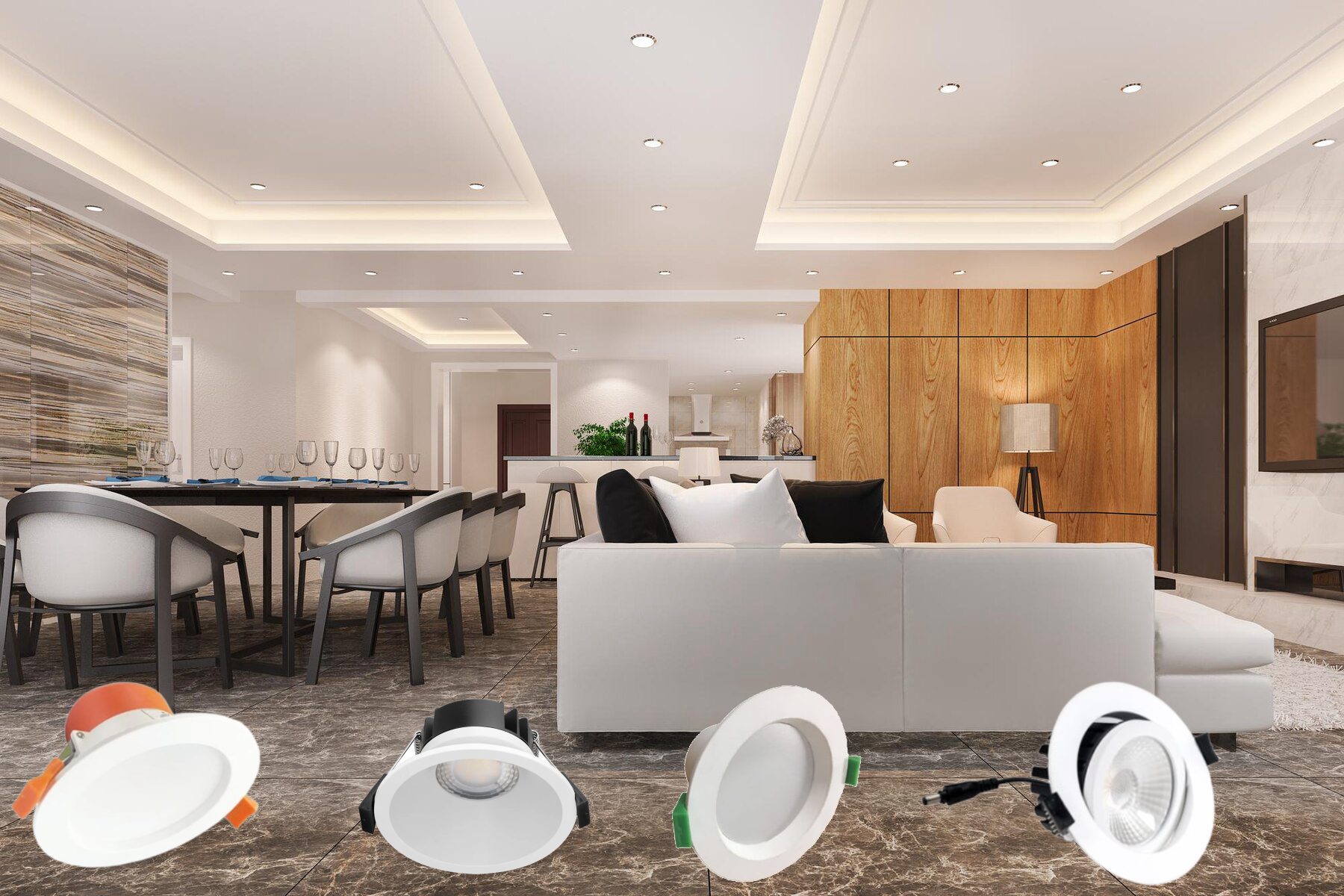
Recessed LED downlights mount directly into your ceiling. They shine light straight down into your room. These fixtures sit flush with the ceiling. They create clean, professional-looking spaces without bulky visible hardware.
Traditional downlights waste energy as heat. LED versions convert 80% of electricity into light. The remaining 20% generates minimal heat. This makes LED downlights more efficient and safer.
Recessed LED downlights work in kitchens, bathrooms, offices, retail stores, and warehouses. You can use them anywhere you need focused, downward-facing light. They replace older incandescent, halogen, and fluorescent systems.
Key Differences: LED vs Traditional Downlights
Traditional downlights consume 50-100 watts per fixture. LED downlights use 8-15 watts to produce the same brightness. This difference matters on your electricity bill.
A traditional 50-watt downlight costs $60 yearly to operate (based on 12 hours daily use). An LED equivalent costs just $12 yearly. That’s $48 saved per fixture annually.
Older bulbs last 1,000-2,000 hours. LED downlights run for 50,000-100,000 hours. You’ll replace traditional bulbs every 1-2 years. LED bulbs last 15-25 years in typical homes.
Heat output differs significantly. Traditional downlights produce substantial heat. This increases air-conditioning costs in summer. LED fixtures stay cool, reducing HVAC strain.
Understanding LED Retrofit Kits
LED retrofit kits upgrade existing recessed fixtures. You don’t need to tear out old housing or electrical wiring. Simply remove the old bulb and insert the LED module.
Retrofit kits include the LED component, mounting hardware, and driver circuitry. Everything needed for installation comes in one package. Installation typically takes 10-15 minutes per fixture.
Retrofit kits cost 40-60% less than complete fixture replacement. You save money on labor and construction disruption. This makes retrofitting ideal for busy homes or commercial buildings.
Many retrofit kits fit standard recessed housing sizes. Common sizes include 4-inch, 5-inch, and 6-inch fixtures. Check your existing fixture dimensions before ordering. The wrong size won’t fit properly.
Quality retrofit kits include thermal management features. Heat sinks and advanced drivers keep components cool. Poor-quality kits generate heat and fail prematurely. Investing in premium kits pays off through longer lifespan.
Brightness and Lumens Explained
Lumens measure light output, not brightness. More lumens mean more light. A fixture’s lumens determine how bright your room becomes.
The room size dictates lumen requirements. A small bathroom needs 500-1,000 lumens. A kitchen island needs 2,000-3,000 lumens. A large warehouse needs fixtures with 8,000+ lumens.
A common rule: multiply room square footage by 10-20. This gives you total lumens needed. A 200-square-foot room needs 2,000-4,000 lumens total.
Spacing fixtures properly prevents dark spots. Space fixtures 4-6 feet apart for even coverage. Closer spacing ensures uniform brightness throughout.
Traditional 50-watt downlights produce 500-700 lumens. Equivalent LED fixtures produce 600-850 lumens. LED efficiency means you get more light with less power.
Color Temperature for Different Spaces
Color temperature is measured in Kelvin (K). It describes whether light looks warm or cool.
2700K (Warm White): Creates cozy, relaxing atmospheres. Perfect for bedrooms, living rooms, and dining areas. Makes spaces feel inviting and intimate.
4000K (Neutral White): Balances warmth and brightness. Works well in offices, kitchens, and hallways. Provides comfortable lighting for work and daily tasks.
5000K (Cool White): Enhances alertness and focus. Ideal for retail spaces, workshops, and task-specific areas. Makes colors appear more vivid and true-to-life.
Warmer tones (2700K) reduce eye strain during relaxation. Cooler tones (5000K) improve visibility for detailed work. Choose based on room purpose and desired atmosphere.
Mixing color temperatures in one room looks awkward. Stick to one temperature throughout a space. This creates cohesive, professional-looking lighting.
Calculating Energy Savings
Energy savings depend on wattage difference and operating hours. Calculate annual savings this way:
Step 1: Determine current fixture wattage. Traditional halogen downlights use 50-75 watts. Incandescent use 40-60 watts.
Step 2: Find your local electricity rate. Check your utility bill (usually $0.10-$0.20 per kilowatt-hour). Regional rates vary significantly.
Step 3: Estimate daily operating hours. Residential fixtures run 4-6 hours daily. Commercial fixtures run 10-14 hours daily.
Step 4: Calculate the math. A 50-watt fixture running 12 hours daily uses 6 kilowatt-hours monthly. At $0.15 per kilowatt-hour, that costs $10.80 monthly or $129.60 yearly. An LED replacement using 10 watts costs just $25.92 yearly. The difference is $103.68 yearly per fixture.
Step 5: Multiply by total fixtures. A home with 30 fixtures saves $3,110 yearly. A small office with 50 fixtures saves $5,184 yearly.
Most properties recoup LED investment within 2-4 years. After that, savings are pure profit.
Selecting the Right LED Downlight
Match your existing fixture dimensions. Most homes have 4-inch or 5-inch fixtures. Some older homes use 3.5-inch models. Measure before ordering.
Check if your ceiling is insulated. IC-rated (insulation contact) fixtures handle insulation contact safely. Non-IC fixtures risk overheating if insulation touches them. Most new installations require IC-rated fixtures.
Verify dimmer compatibility if needed. Not all LED fixtures work with all dimmers. Check compatibility lists from manufacturers. Incompatible dimmers cause flickering and buzzing.
Choose a CRI (Color Rendering Index) above 90. CRI measures color accuracy. Above 90 shows true colors. Below 80 distorts colors.
Consider adjustable color temperature models. These shift between 2700K and 5000K. Programmable models let you change tone by season or time.
Check warranty coverage. Premium fixtures offer 5-10 year warranties. Budget models offer 1-2 years. Longer warranties indicate manufacturer confidence.
Read customer reviews for reliability. Look for complaint patterns about flickering, early failure, or heat issues. High-rated models show proven durability.
Common Installation Mistakes to Avoid
Don’t install non-IC fixtures in insulated ceilings. This causes overheating and premature failure. Always check insulation ratings.
Don’t exceed the fixture’s rated wattage. Using higher-wattage bulbs damages wiring and creates fire hazards. Respect maximum specifications.
Don’t use incompatible dimmers. Mixing LED fixtures with old dimmer switches causes flickering. Replace old dimmers with LED-compatible versions.
Don’t skimp on electrical connections. Loose wire connections generate heat and cause fires. Use proper terminals and test connections carefully.
Don’t install fixtures too close together. This creates excessive heat and reduces fixture lifespan. Follow spacing guidelines for air circulation.
Don’t forget vapor barriers in humid spaces. Bathrooms need sealed fixtures to prevent moisture damage. Moisture enters fixtures and causes electrical failure.
Don’t ignore manufacturer instructions. Each fixture type has specific requirements. Following steps prevents problems and maintains warranties.
Lifespan and Maintenance Benefits
LED downlights last 50,000-100,000 hours. Most last 15-25 years in residential use. This eliminates constant replacement schedules.
Maintenance becomes virtually non-existent. You’re not changing bulbs every year. Spare bulbs and replacement costs disappear.
Long lifespan reduces labor costs in commercial settings. Maintenance staff spends time elsewhere instead of climbing ladders. Facility disruption from maintenance stops.
Older technologies require annual maintenance checks. LED fixtures need inspection only during routine building maintenance. This frees up labor hours.
No mercury or hazardous materials in LED bulbs. Disposal costs nothing. You simply replace them in normal trash. Environmental impact is minimal.
Dimming and Smart Controls
Standard dimmers rarely work with all LED fixtures. LED-compatible dimmers have different electronics than traditional dimmers. Check compatibility before assuming your dimmer works.
Some LED retrofit kits include built-in dimming capability. These work with most old dimmers. Others require dimmer replacement.
Smart lighting systems integrate LED downlights into home automation. Control brightness and color temperature from your phone. Schedule lights to turn on/off automatically.
Tunable white fixtures shift color temperature automatically. Morning shifts toward energizing cool tones. Evening shifts toward relaxing warm tones. This aligns lighting with circadian rhythms.
Motion sensors integrate with LED fixtures for unoccupied spaces. Bathrooms, hallways, and closets turn off when empty. This saves additional energy in busy homes.
Code Compliance and Safety
Building codes require proper electrical installation. Licensed electricians understand local requirements. DIY work may violate codes in some areas.
Insulation contact ratings matter in attics and crawl spaces. Non-compliant installations violate codes and void insurance. Always verify IC ratings.
Fire ratings apply in specific locations. Commercial buildings have different fire code requirements than homes. Check local regulations before installation.
Electrical permits may be required. Some jurisdictions require permits for lighting work. Others allow homeowner DIY without permits. Check with your local building department.
GFCI protection applies near moisture sources. Bathrooms, kitchens, and exterior fixtures may require GFCI circuits. Improper installation creates shock hazards.
Making Your Choice
LED downlights save money immediately through lower electricity use. They provide better light quality than older technologies. Installation is straightforward for retrofit kits. You avoid expensive demolition and rewiring.
Long lifespan means you won’t think about lighting for decades. Dimming and smart controls add convenience. Energy savings compound annually.
Start with one room to test performance. See how brightness feels. Confirm color temperature matches your preference. Then expand to other spaces.
Calculate your specific savings using local electricity rates. Most homes save hundreds yearly. That makes sense for any budget.