


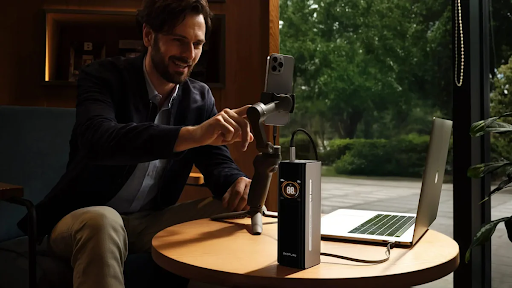
Venturing into the backcountry feels liberating, yet modern safety still depends on electronics craving energy. A power bank keeps phones, GPS beacons, action cameras, and LED lanterns alive when trailheads fade. Choosing the right unit means balancing weight, usable capacity, and durability instead of grabbing the first glossy brick. This guide shows how the proper power bank changes a trek’s rhythm, matches real output to daily needs, and reveals trail habits that squeeze every watt hour. Follow these steps to hike farther, capture richer memories, and always stay reliably reachable across remote wild valleys.
Why Campers Need a Power Bank
Navigation, weather updates, and emergency calls now happen on a single smartphone, yet that convenience vanishes once the battery icon turns red. A robust power bank acts as an energy reserve that prevents critical gear from failing halfway up a ridge. Unlike disposable cells, a rechargeable power bank delivers consistent current to a radio, an avalanche beacon, or a satellite communicator, making the difference between self-rescue and an overnight wait for help. Because it stores energy produced at home, the power bank also reduces reliance on campgrounds that charge per outlet, letting you pick wilder camps far from crowds. For backpackers who log routes in mapping apps, a dependable power bank preserves the track log for future sharing and analysis.
Photography lovers discover that cold dawn air drains camera batteries rapidly. A high-capacity power bank refuels mirrorless camera packs while you brew morning coffee, so you never miss the alpenglow shot. At night, the same power bank revives a dim headlamp and powers a mini lantern for reading. Sharing group memories is easier too: pass the power bank around during lunch, top up everyone’s phone, and avoid splitting the group to hunt for plugs. Ultimately, a quality power bank delivers peace of mind that frees you to enjoy the scenery rather than obsess over the percentage on a tiny screen.
Assessing Your Real-World Power Requirements
Start by writing a simple table of every device you plan to carry, then list its battery size in watt hours. A flagship phone averages 15 Wh, a GPS watch 5 Wh, a drone pack 40 Wh, and a headlamp around 4 Wh. Multiply each figure by how many times you expect to recharge over the trip. A three-night trek that includes two drone flights and nightly photo sessions can easily consume 150 Wh. That calculation proves why a pocket sized power bank that promises 10 000 mAh, or roughly 37 Wh, falls short once losses and cold weather reduce efficiency.
Remember that manufacturer ratings refer to internal cell voltage, usually 3.7 V, not the 5 V output you actually draw. Conversion losses average ten percent, and low temperatures can subtract another twenty. Aiming for a power bank that covers at least one and a half times your estimated need builds a safety buffer. If numbers intimidate you, online calculators and spreadsheet templates automate the math: enter battery specs, trip length, and desired reserve, and they recommend a matching power bank class. By understanding the numbers before you buy, you avoid lugging needless weight or, worse, discovering on day two that the power bank is empty.
Critical Specs That Separate One Power Bank from Another
Capacity dominates marketing, yet capacity means little without context. Convert milliamp hours to watt hours by multiplying by 3.7 and dividing by 1000, then compare that value among models. A 20 000 mAh unit equals 74 Wh; if a power bank offers 85 % efficiency, expect roughly 63 Wh delivered. Charging protocol support matters just as much. Power Delivery at 30 W fills laptops fast, while Quick Charge revitalizes older phones. Multiple USB-C ports let a power bank share current between a phone and a headlamp without wasting time. Look for pass-through capability so you can feed a solar panel into the power bank while it feeds gear, turning midday rest stops into productive energy sessions.
Port construction deserves scrutiny. Recessed connectors protected by silicone flaps keep sand and rain away, extending the lifespan of a power bank. LED status bars are easier to read under bright sun than tiny numbered indicators. Smart current distribution prevents the power bank from throttling when all ports are in use. Study independent reviews that record continuous discharge curves; a cheap power bank often sags below 4.8 V under load, which can trigger phone charging errors. Invest once in a well-regulated power bank, and every device you carry benefits.
Weather Resistance and Durability in the Backcountry
Backcountry conditions punish electronics. An IP65-rated shell keeps dust from grinding switches and blocks rain blown under a tarp. Rubber bumpers absorb knocks when the pack tumbles off a boulder. Choose a power bank that passes drop tests from at least one meter onto concrete; brands that publish videos usually stand behind the claim. Cold resilience is important too. Lithium cells cannot accept a charge below freezing without damage, so many premium power banks include firmware that pauses charging until the internal pack warms. Sleeping with the power bank in a hood pocket is a lighthearted but effective technique.
Altitude introduces ultraviolet exposure and thinner air, both of which accelerate plastic fatigue. Casing made of polycarbonate is more stable than cheap ABS. If you hike in humid jungles, corrosion can creep into ports even when the power bank sits unused; nickel-plated connectors resist that. Before the trip, run a home water splash test under the faucet and confirm every port cover seals tight. Should the power bank fall in a stream, immediately shake water out, dry the exterior, and let it rest in sunlight before reconnecting devices. Caring for the power bank on trail extends its service life as surely as caring for boots or a tent.
Smart Packing: Balancing Weight, Size, and Capacity
Every gram you add must pay rent in performance. A 10 000 mAh power bank weighs close to 180 g, while a 26 800 mAh model can exceed 500 g. Map your resupply points: if a hut with outlets appears every second day, a smaller power bank may suffice. Yet on a seven-day traverse, the heavier pack becomes a necessity. Form factor also influences comfort. Long narrow designs tuck beside a hydration bladder, whereas broad flat banks slip under a notebook at camp. Hold candidate power banks in hand and imagine locating them by feel at night; edges should be rounded to avoid tearing fabric.
Air travel restrictions complicate decisions. International regulations limit carry-on lithium batteries to 100 Wh, roughly a 27 000 mAh power bank. Choosing a 96 Wh model extracts the most energy without triggering airline paperwork. Always tape or cap exposed cable ends so metal cannot short circuit during security scans. Store the power bank in a seat-back pocket during flight rather than overhead bins; easy access prevents accidental crush damage. At camp, place the power bank in a mesh side pocket for rapid grab and go during breaks. Efficient packing keeps weight balanced and safeguards the power bank from punctures.
Field Tested Tips to Extend Power Bank Life Outdoors
Treat the power bank like any precision tool. Charge it fully the night before departure, then disconnect the cable so it rests at 100 % for the shortest time possible. In camp, keep the power bank inside a hat or sleeping bag pocket to preserve warmth; warm cells release more capacity. Use short certified cables because voltage drop across long thin wires wastes stored energy.
Rotate through ports so each connector experiences equal insertion cycles, preventing uneven wear. If your power bank offers Bluetooth diagnostics, check cycle count and cell health before every season. Once the count approaches 500 cycles, retire the power bank from expedition duty and keep it for commuting. During storage between trips, discharge the power bank to roughly forty percent, then place it in a cool drawer. Set a calendar reminder to wake the power bank every three months for a short top up; idle cells last longer when exercised gently. Follow these habits and a premium power bank will serve faithfully across countless trails.