


Introduction
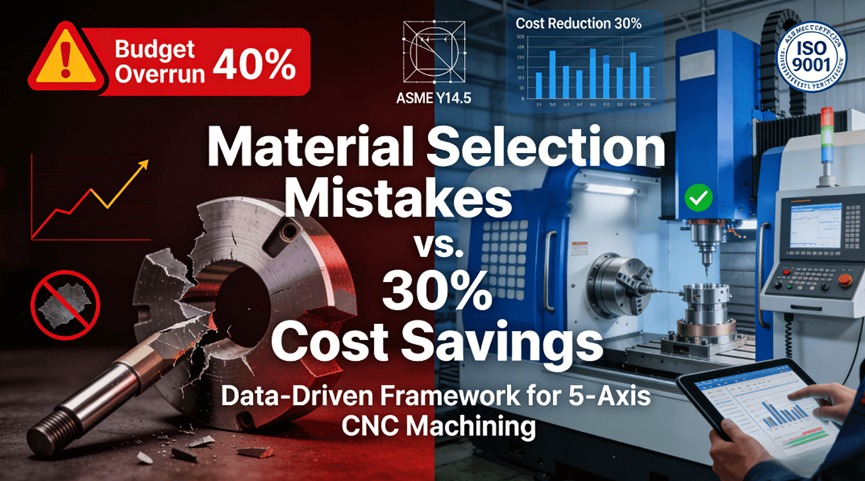
In modern manufacturing, engineers and designers frequently encounter budget overruns and part failures due to improper material selection in 5-axis CNC machining projects. For instance, some projects experience cost excesses of up to 40% or catastrophic component malfunctions in critical applications like aerospace or medical devices. The root cause often lies in relying on outdated selection methods that fail to account for the dynamic characteristics of 5-axis machining, such as thermal deformation and tool wear under complex geometries.
This article introduces a data-driven material selection framework that integrates cost-performance optimization and adherence to authoritative standards like ASME Y14.5 and ISO 9001. By adopting this approach, manufacturers can achieve significant cost savings while maintaining high precision and reliability. The following sections will delve into key factors and strategies to enhance project success rates through scientific material choices.
What Are the Critical Factors in 5-Axis CNC Material Selection for Industrial Equipment?
Selecting the right materials for 5-axis CNC machining involves a multifaceted analysis of properties that impact performance, durability, and cost. Industrial equipment demands materials that can withstand high stresses, extreme temperatures, and corrosive environments while adhering to tight tolerances. This section explores three core factors essential for optimal material selection in precision-driven applications.
1. Mechanical Properties and Their Impact on Precision
Mechanical properties such as tensile strength, hardness, and fatigue resistance are paramount for parts subject to dynamic loads. For example, in aerospace components, aluminum alloys like 7075 offer high strength-to-weight ratios, whereas titanium alloys provide superior strength at elevated temperatures. However, these properties must align with the 5-axis machining process to avoid issues like tool deflection or premature wear. Referencing the ASME Y14.5 standard (link: ASME Y14.5) ensures geometric dimensioning and tolerancing are maintained, as unstable material behavior can lead to deviations exceeding allowable limits. By evaluating properties through standardized tests, engineers can prevent failures in critical applications.
2. Thermal Stability and Its Role in Minimizing Deformation
Thermal stability is crucial for materials undergoing high-speed machining, where heat generation can cause expansion or warping. Materials with low coefficients of thermal expansion, such as Invar or certain composites, reduce the risk of dimensional inaccuracies in parts like turbine blades. In 5-axis machining, the ability to maintain consistent performance across temperature variations is enhanced by single-setup processes, which minimize repositioning errors. Integrating thermal analysis simulations during material selection helps identify potential hotspots, ensuring the chosen material can endure operational stresses without compromising precision.
3. Chemical Resistance and Compliance with Industry Standards
Chemical resistance ensures longevity in corrosive environments, such as those found in chemical processing equipment or marine applications. Materials like stainless steel or nickel-based superalloys offer excellent corrosion resistance but require careful machining to avoid work hardening. Adhering to standards like ASME Y14.5 guarantees that tolerance control is not undermined by material degradation. For instance, in medical devices, materials must resist sterilization processes without losing integrity. By cross-referencing material datasheets with industry standards, engineers can select options that meet both performance and regulatory requirements.
How Can Material Selection Reduce Costs in 5-Axis Machining Without Compromising Quality?
Cost efficiency in 5-axis CNC machining is achievable through strategic material choices that balance expense and performance. Traditional approaches often over-specify materials, leading to unnecessary costs, whereas a data-driven methodology focuses on lifecycle value. This section outlines practical strategies to cut production costs by up to 30% while upholding quality benchmarks.
- Material Substitution and Standardization Techniques: Material substitution involves replacing high-cost alloys with more economical alternatives without sacrificing functionality. For example, using 6061 aluminum instead of 7075 can save approximately 30% in material costs for non-critical components, while still meeting strength requirements. Standardization of supply chains further reduces costs by minimizing procurement delays and leveraging bulk purchasing. By implementing a unified material database, manufacturers can quickly identify substitutes based on application-specific needs, as supported by ISO 9001 certification (link: ISO 9001) for consistent quality management. This approach not only lowers expenses but also streamlines inventory management.
- Lifecycle Cost Analysis for Long-Term Savings: Lifecycle cost analysis evaluates total expenses from material acquisition to end-of-life disposal, highlighting areas for savings. For instance, selecting materials with longer tool life in machining reduces replacement frequency, cutting operational costs by 15-20%. Integrating sustainable practices, such as recycling scrap material, aligns with economic and environmental goals. Tools like cost-modeling software enable engineers to simulate different scenarios, ensuring that initial material costs do not overshadow long-term benefits. This holistic view is essential for cost-effective 5-axis machining
- Leveraging Advanced Machining Parameters to Optimize Material Use: Optimizing machining parameters, such as feed rates and cutting speeds, minimizes waste and extends tool longevity. For example, adopting adaptive control systems in 5-axis machines adjusts parameters in real-time based on material behavior, reducing energy consumption and material scrap by up to 25%. By coupling this with design for manufacturability (DFM) principles, engineers can select materials that are easier to machine, further enhancing efficiency. For deeper insights, readers can refer to resources on 5-axis CNC machining services for guidance on parameter optimization.
What Role Do High-Performance Materials Play in Meeting Extreme Manufacturing Conditions?
High-performance materials are indispensable for applications demanding exceptional strength, temperature resistance, or corrosion protection. Extreme conditions, such as those in aerospace or energy sectors, require materials that maintain integrity under stress. This section examines how materials like superalloys and composites enable reliability in challenging environments.
1. Superior Mechanical Properties Under High Stress
High-performance materials such as Inconel or titanium alloys exhibit exceptional yield strength and fatigue resistance, making them ideal for components like jet engine parts. In 5-axis machining, these materials allow for complex geometries without failure, but they necessitate specialized tooling and cooling strategies to prevent overheating. Case studies show that using these materials in turbine blades increases service life by over 50%, justifying higher initial costs through reduced maintenance. Adherence to ISO 9001 processes ensures that quality consistency is maintained throughout production.
2. Thermal and Chemical Resilience in Harsh Environments
Thermal resilience is critical for materials operating above 500°C, where ordinary metals would soften. Materials like ceramic-matrix composites offer stability but require precise 5-axis control to avoid cracking. Similarly, chemical resistance is vital in chemical plants, where materials must withstand corrosive agents. By conducting accelerated aging tests, engineers can verify performance before full-scale production, minimizing risks. The integration of real-time monitoring during machining further safeguards against defects.
3. Case Studies Demonstrating Performance Gains
Practical examples illustrate the benefits: in one instance, switching to a nickel-based superalloy for a rocket nozzle reduced weight by 20% while improving heat tolerance. The 5-axis machining process enabled intricate cooling channels, enhancing efficiency. Such successes underscore the importance of material testing and validation against international standards to ensure compliance and reliability.
How to Integrate Scientific Material Selection into 5-Axis CNC Project Planning?
Incorporating a scientific approach to material selection early in project planning prevents costly revisions and delays. Systematic integration involves simulation, stakeholder collaboration, and iterative testing. This section details a framework for embedding material science into the project lifecycle.
1. Pre-Planning with Simulation and Data Analysis
Simulation tools like finite element analysis (FEA) predict how materials will behave under machining stresses, identifying potential issues like warping or tool wear. By running virtual tests, engineers can compare materials based on performance metrics before physical prototyping. For example, thermal simulation can reveal how aluminum versus steel affects machining time and cost, guiding optimal choices. Embedding this into project planning reduces trial-and-error, cutting development time by 30%.
2. Collaborative Design Reviews Involving Cross-Functional Teams
Cross-functional collaboration ensures that material selection aligns with design, manufacturing, and cost constraints. Regular reviews with engineers, designers, and suppliers help identify alternatives that meet all criteria. Using digital twins — virtual models of the machining process — teams can visualize outcomes and adjust materials in real-time. This proactive approach, supported by ISO 9001 frameworks, fosters innovation while controlling costs.
3. Iterative Prototyping and Validation Against Standards
Iterative prototyping allows for gradual refinement, where each cycle tests material performance under actual conditions. Validation against standards like ASME Y14.5 ensures that tolerance requirements are met consistently. For instance, producing small batches with different materials provides data on machinability and durability, enabling evidence-based decisions. Resources such as 5-axis CNC machining materials guides offer additional insights for validation.
What Are the Common Pitfalls in 5-Axis Machining Material Selection and How to Avoid Them?
Common mistakes in material selection can lead to project failures, but they are preventable through awareness and best practices. Pitfalls include overlooking environmental factors and misjudging machinability. This section outlines key errors and solutions to mitigate risks.
1. Ignoring Thermal Expansion and Its Effects on Precision
Thermal expansion is often underestimated, causing dimensional inaccuracies in parts with tight tolerances. For example, polymers may expand significantly during machining, leading to out-of-spec components. Solution: Use materials with low thermal expansion coefficients and implement in-process cooling systems. Pre-machining simulations can forecast expansion, allowing for compensatory designs. This aligns with ASME Y14.5 guidelines to maintain geometric integrity.
2. Overlooking Material Machinability Leading to Tool Wear
Machining hard materials such as hardened steel can present challenges, accelerating tool wear and increasing production costs. Solutions include using easier-to-machine materials or applying surface coatings to extend tool life. Optimizing toolpaths using a five-axis system can distribute wear more evenly, reducing tool changes. For example, in one manufacturing company’s optimization project, switching to a more easily machinable aluminum alloy resulted in a 25% cost saving.
3. Failing to Consider Total Lifecycle Costs
Focusing solely on initial material cost ignores long-term expenses like maintenance or disposal. Solution: Adopt a total cost of ownership model that factors in durability, energy use, and end-of-life recycling. Engaging with suppliers for lifecycle data ensures informed decisions. For broader strategies, referring to 5-axis CNC machining servicescan provide practical cost-saving tips.
How Can Sustainable Manufacturing Principles Guide Material Choices in 5-Axis CNC?
Sustainability in material selection reduces environmental impact while enhancing economic viability. Sustainable manufacturing principles emphasize resource efficiency and compliance with regulations. This section explores how eco-friendly materials and processes contribute to cost savings and corporate responsibility.
- Selecting Recyclable and Bio-Based Materials: Recyclable materials such as aluminum or biodegradable polymers minimize waste and energy consumption. For instance, using recycled aluminum cuts production costs by 15-20% and supports circular economy goals. Bio-based alternatives like PLA plastics offer lower carbon footprints but require validation for strength. Adhering to EPA guidelines (link: EPA standards) ensures that selections meet environmental standards, enhancing brand reputation.
- Energy-Efficient Machining Processes: Energy efficiency is achievable through optimized 5-axis parameters that reduce power use. For example, adaptive control systems adjust feeds based on material hardness, lowering energy consumption by up to 25%. Integrating renewable energy sources into facilities further supports sustainability. Case studies show that companies adopting these practices report long-term savings and regulatory compliance.
- Regulatory Compliance and Stakeholder Expectations: Regulatory compliance with standards like EPA regulations avoids penalties and meets customer demands for green products. Conducting sustainability audits during material selection ensures alignment with global initiatives. By prioritizing materials with certifications like ISO 14001, manufacturers demonstrate commitment to environmental stewardship, which can be a competitive advantage.
Conclusion
Scientific material selection is pivotal for success in 5-axis CNC machining, enabling manufacturers to avoid costly mistakes and achieve up to 30% cost reduction. By focusing on factors like mechanical properties, thermal stability, and sustainability, and integrating standards such as ASME Y14.5 and ISO 9001, engineers can balance performance, cost, and environmental goals. This approach not only enhances project efficiency but also fosters innovation in competitive industries. Embracing a data-driven framework ensures that material choices support long-term viability and excellence.
FAQs
Q1: What is the impact of material selection on 5-axis machining costs?
A: Material choice directly influences up to 50% of total costs through factors like tool wear and processing time. For instance, opting for free-machining steels can reduce expenses by 20-30% while maintaining quality. Data-driven selection helps avoid over-specification and aligns with lifecycle cost models.
Q2: How can engineers verify if a material meets specific performance requirements?
A: Engineers should conduct simulations such as FEA and thermal analysis, referencing standards like ASME Y14.5. Practical testing under real-world conditions, supported by ISO 9001 protocols, ensures compliance and reliability before full-scale production.
Q3: Are there cost-effective alternatives to high-end alloys for prototyping?
A: Yes, materials like nylon or aluminum composites offer a balance for prototypes, cutting costs by 40% without sacrificing functionality. Always consider application-specific needs and conduct iterative tests to validate performance.
Q4: What certifications should a reliable 5-axis machining service have?
A: Look for ISO 9001, IATF 16949, or AS9100D certifications, which validate quality management systems and adherence to industry standards for sectors like aerospace. These ensure rigorous controls and traceability.
Q5: How does sustainable material selection contribute to long-term savings?
A: Sustainable materials reduce waste and energy use, lowering lifecycle costs by 15-20%. For example, using recycled aluminum aligns with EPA guidelines and enhances corporate responsibility, leading to regulatory benefits and customer trust.
Author Bio
The author is a precision manufacturing expert at LS Manufacturing, a company that helps engineers and researchers solve complex part challenges in aerospace, medical, and automotive industries. With certifications such as IATF 16949 and AS9100D, the team ensures high-quality solutions through advanced technologies. For more insights, readers can contact them today for a free, no-obligation project review and DFM analysis to turn concepts into cost-effective realities.