


Did you know that the U.S. spends nearly $12,000 on a person’s healthcare every year?
Shocking, right? But what’s even more surprising is that a big part of this cost comes from the very systems meant to reduce it—generic EHRs.
Why does this happen?
The reason is that off-the-shelf EHRs rarely match the clinic’s workflows. Productivity drops, documentation takes longer, claim errors increase, and providers end up paying for inefficiencies they never created.
And when your system hinders operations rather than streamlining them, your practice’s ROI takes a direct hit. The outcome — you invest, but the returns never live up to what you expect.
This is exactly where custom EHR software development steps in and delivers real ROI. When you build a tailored EHR solution that matches your workflows, practice-specific needs, and has true interoperability with every tool and system, your ROI improves automatically. This happens through better throughput, fewer billing errors, faster documentation, reduced burnout, and seamless data flow.
However, the real question is: how do you calculate this EHR software ROI, and how does custom EHR software development deliver ROI?
So, in this blog, we will break that down. We will explore the benefits of custom EHR systems, how they generate measurable returns, and why clinics and hospitals that choose a tailored, scalable, HIPAA-compliant EHR stay ahead.
What Is Custom EHR Software Development?
Well, before we get into exploring how custom EHRs improve ROI, let’s first understand what custom EHR development is. If we put it in simple terms, custom EHR development is the process of building Electronic Health Records (EHR) that fit your practice, workflows, specialty, and the way you work.
Unlike off-the-shelf EHRs that force providers to adapt to their workflows, a custom EHR is designed around your processes. And this one difference makes all the difference in healthcare, where each specialty has its own needs.
For instance, behavioral health requires detailed psychotherapy notes, care plans, and telehealth integration. Whereas orthopedics needs image-heavy workflows, templates, and seamless PACS integration.
That’s why, when clinics and hospitals use a generic EHR with one-size-fits-all workflows, it brings costs, delays, and documentation errors for the clinics. A custom-built EHR eliminates all these issues by bringing in EHR workflow automation, data accuracy, and interoperability.
The result? Faster documentation, higher productivity, and a system that truly supports your operations rather than hindering them. All this improves ROI significantly, but why does EHR software ROI matter so much? Well, let’s understand that.
Why ROI Matters in Healthcare Digitization
Today, for healthcare, ROI is not just a financial metric — it has become a survival metric. With value-based care models reshaping reimbursements, staff shortages making delivering care difficult, and operational costs rising every year, clinics need technology that keeps up with these changes.
That’s why every investment made in healthcare tech, especially one as big as EHR, has to bring value to the investment. And this makes evaluating EHR software ROI important. So, a custom EHR that automates documentation, reduces administrative burden, accelerates billing, and improves accuracy frees clinicians’ time for generating revenue and ROI.
Moreover, with robust EHR integration services, data runs smoothly through the system, streamlining operations and practices, and resulting in measurable financial gains. In short, digitization becomes profitable only when it brings good ROI. This is where custom healthcare software development helps clinicians make the most of their investments, and here is how.
Key ROI Drivers of Custom EHR Software Development
As I said earlier, custom EHR matches your workflows and delivers ROI as it addresses the exact bottlenecks. It eliminates workflow inefficiencies, documentation overload, billing errors, and limited scalability.
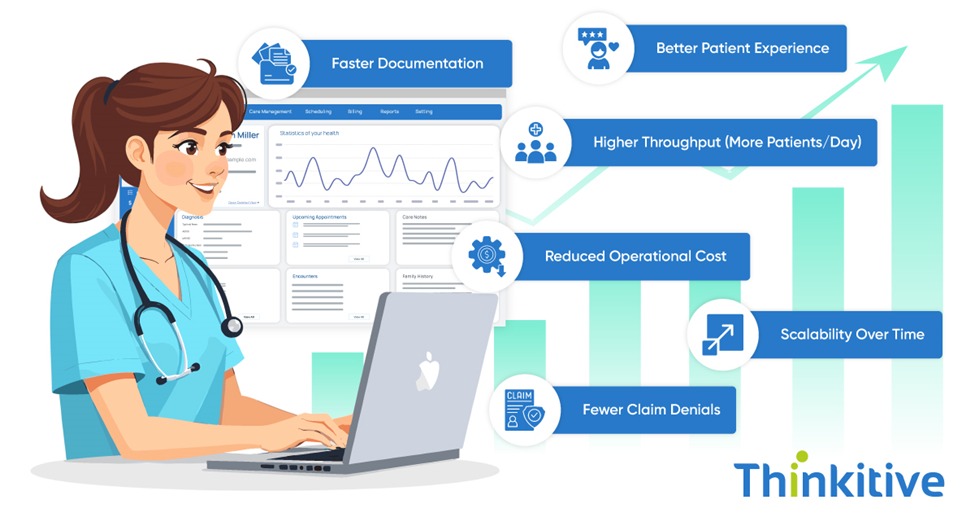
Here’s how a tailored EHR solutions drive ROI in clinics by turning challenges into measurable financial gains:
- Improved Clinical Efficiency & Time Savings: A custom EHR gives clinicians customized templates, structured forms, and workflow automation designed around their daily routine. This speeds up documentation and supports faster, more accurate charting while freeing up the providers; moreover, with built-in, specialty-specific clinical decision support tools that also streamline workflows, increasing productivity and care quality, directly boosting EHR software ROI.
- Increased Patient Throughput: When the EHR is tailored to match every step of the patient journey, onboarding becomes faster. In addition, automated intake and smart scheduling reduce bottlenecks that slow clinics down. Features such as automated no-show reminders, integrated telehealth, and real-time appointment updates help practices serve more patients per day without hiring new staff, saving you from additional costs.
- Reduced Operational Costs: A custom EHR eliminates the need for multiple disconnected tools. Built-in billing automation, coding support, claims tracking, and reporting reduce administrative overhead. With robust EHR integration services, data moves seamlessly across labs, pharmacy systems, imaging systems, and billing, cutting long-term maintenance costs.
- Error Reduction & Fewer Claim Denials: With accurate and structured data capture, applying for claims becomes easier, and the acceptance rate is increased. By reducing documentation gaps and coding errors, clinics see fewer denials and faster reimbursements. Moreover, custom EHRs embed security, audit-trails, and HIPAA-compliant workflows from the start, lowering compliance risks and any fines.
- Better Patient Experience & Retention: Patient experience becomes much smoother with a custom-built patient portal, personalized care workflows, and automated follow-ups. When communication is streamlined and care is more tailored for the individual rather than the group, retention improves. It is also driving long-term revenue stability for clinics and hospitals.
- Scalability that Eliminates Rebuild Costs: Unlike rigid generic EHRs, scalable EHR systems grow with your practice. Whether you add new providers, open new locations, or expand services, modular custom EHR development prevents costly system overhauls. This scalable solution significantly boosts ROI over the years.
How Custom EHR Software Development Builds Long-Term Value
Custom EHR software development is a solution that delivers long-term returns. These systems align with how U.S. practices actually operate; a tailored EHR becomes a sustainable solution rather than a system that needs constant workarounds. Here is how these solutions build lasting value for clinics:
- Full Integration with the Healthcare Ecosystem: Custom EHR seamlessly integrates with labs, PACS, HIEs, pharmacies, billing systems, and telehealth platforms using HL7 and FHIR standards. This eliminates data silos and reduces the cost of maintaining multiple disparate systems. With robust EHR integration services, clinics benefit from clean data flow, fewer errors, and smoother operations.
- Support for Value-Based Care Models: Tailored EHR solutions help providers track outcomes, identify care gaps, and document quality measures required for incentive payments. As value-based care expands, a specialty-specific, interoperable EHR becomes essential for delivering measurable results and improving long-term reimbursements.
- Data Analytics for Revenue Optimization: Custom EHR systems offer advanced analytics that highlight operational bottlenecks, rising denials, and missed revenue opportunities. Predictive insights and automated financial dashboards transform the EHR into a revenue optimization engine, creating sustainable EHR software ROI over the years.
How a Multi-Specialty Clinic Leveraged Custom EHR
While understanding the intricacies of how custom EHR boosts ROI for hospitals and clinics is well and good, nothing cements this better than an example. So, here is a hypothetical scenario explaining how ROI is boosted by a custom EHR system.
A multi-specialty clinic in New York had a quite long intake process, and documenting patient details was a time-consuming task. With multiple specialties and only one template that did not have all the right fields, every clinician had to click through unnecessary screens.
This increased not only the time required to document but also affected provider productivity and reduced patient engagement and retention. To overcome this, the clinic built a custom EHR that enables clinicians to customize templates to their needs.
After switching to a custom EHR software solution with specialty-specific templates and automated charting workflows, documentation time dropped by nearly 30%. Most importantly, this allowed clinicians to see more patients, boosting the clinic’s revenue.
In short, after adopting a tailored EHR solution built around their actual workflows, the clinic’s ROI became more sustainable and meaningful.
Key Features to Include in a Custom EHR to Maximize ROI
To maximize ROI from EHR software, your custom EHR system needs the right features. Your software should focus on capabilities that reduce administrative effort, streamline operations, and improve clinical outcomes.
For best results, having specialty-specific templates, automated charting, and role-based task flows is essential. This customization ensures clinicians spend less time documenting and more time focusing on delivering care.
Then comes smart scheduling and automated reminders, which improve patient throughput, reduce no-shows, and help practices fully utilize available clinical hours. When combined with integrated telehealth, clinics can expand access without expanding physical space.
On the financial side, automating billing and RCM integration eliminates costly coding errors, reduces denial rates, and accelerates reimbursements. This is what contributes to long-term revenue stability. Moreover, a modern EHR should also include analytics dashboards that highlight bottlenecks, spot revenue leaks, and support data-driven decision-making.
Finally, FHIR and HL7 interoperability, along with robust HIPAA, SOC 2, and ONC compliance modules, ensure secure data exchange across systems and protect sensitive patient data. When you have all these features together, you have a scalable, efficient, and financially sustainable custom EHR solution built for real-world practice needs.
Conclusion
Right now, healthcare technology is evolving rapidly, and keeping up with the future is necessary. However, you can’t achieve this by adapting a generic EHR. You need a custom EHR solution that is built around your workflows.
Most importantly, you need these systems to ensure you get the return on your investment. While generic EHRs work for basic needs, they also create inefficiencies and, with a lack of interoperability, reduce productivity, revenue, and finally ROI.
So, if you are facing frequent claim denials and need to improve the ROI of your EHR software, then it’s time to switch to tailored EHR solutions. Click here and book your free demo right now, and let’s start your journey towards getting custom EHR development ROI.
Frequently Asked Questions
- What is custom EHR software development?
Custom EHR software development involves building an electronic health record system tailored to a specific clinic’s workflows, specialty needs, and processes. It offers flexibility, better usability, and seamless interoperability—unlike generic EHRs that force providers into rigid, one-size-fits-all workflows.
- How does a custom EHR improve ROI for healthcare providers?
A custom EHR boosts ROI by reducing documentation time, improving billing accuracy, increasing patient throughput, cutting administrative workload, and ensuring smooth data exchange. These efficiencies lower operational costs, reduce errors, and enable providers to see more patients without adding staff.
- How much does custom EHR development cost in the US?
Custom EHR development in the U.S. typically ranges from $150,000 to $600,000+, depending on features, integrations, complexity, and compliance needs. Costs vary widely based on specialty requirements, third-party integrations, and whether advanced modules like telehealth or analytics are included.
- How long does it take to build a custom EHR system?
Building a custom EHR generally takes 6 to 18 months. Timeline depends on feature scope, integration requirements, regulatory compliance work, and the size of the development team. Larger systems with telehealth, RCM, or advanced analytics may take longer.
- What features should a custom EHR include to maximize ROI?
Key ROI-driving features include customized workflows, smart scheduling, automated reminders, billing automation, RCM integration, ePrescribing, analytics dashboards, and FHIR/HL7 interoperability. Strong HIPAA and ONC compliance modules also reduce long-term risk and operational costs.
- How is custom EHR different from ready-made EHR software?
Custom EHRs are built around a practice’s workflows and specialty needs, offering greater flexibility, usability, and integration options. Ready-made EHRs use fixed templates and generic workflows that often require workarounds, reducing efficiency and limiting long-term scalability.
- Is custom EHR development compliant with HIPAA and ONC rules?
Yes, we give importance to HIPAA-compliant EHR development along with alignment with ONC rules. Compliance is integrated during development through secure architecture, audit trails, encryption, access controls, and adherence to national data-exchange requirements.
- Can a custom EHR integrate with existing hospital/clinic systems?
Absolutely, custom EHRs support interoperability using HL7, FHIR, CCD, and API-based integrations. They can connect with labs, PACS, billing systems, telehealth tools, HIEs, and pharmacy platforms—ensuring seamless data flow across your entire technology ecosystem.
- What types of healthcare practices benefit most from custom EHRs?
Specialties with unique workflows—behavioral health, orthopedics, cardiology, oncology, urgent care, and multi-specialty groups—benefit greatly. Practices needing strong integration, automation, or advanced reporting also gain higher ROI from custom solutions.
- Does custom EHR software reduce administrative workload?
Yes, a Custom EHR for clinics and hospitals automates documentation, scheduling, coding, billing, reporting, and intake processes. By aligning with real workflows, they significantly reduce manual tasks and administrative burden, allowing clinicians and staff to focus more on patient care.
Human Score
SEO Semrush Score