


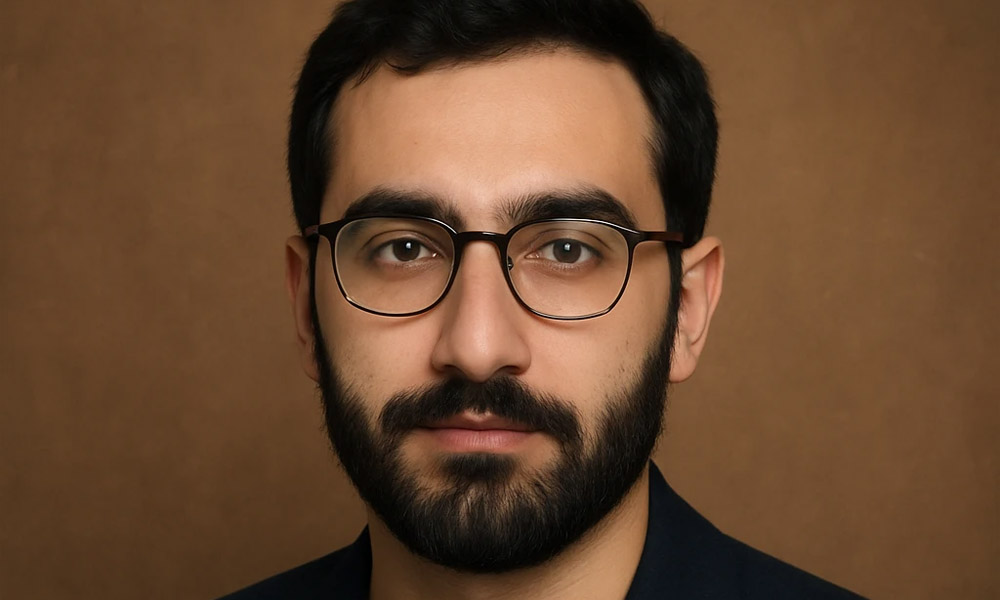
Etibar Eyub is one of the distinctive cultural figures to emerge from the post-Soviet intellectual landscape — a writer whose work connects the philosophical heritage of the East with the dilemmas of a rapidly changing digital world. His books and essays are not merely literary projects; they are attempts to maintain a dialogue about identity, memory, and the responsibilities of the individual before history. For Eyub, creativity became both an inner refuge and a way to understand the world after a tragedy that marked his early life.
Born in the spring of 1986 in Baku, he grew up in a home where books were not simply objects but living companions. His father, Eyub Gasanov, a respected scholar of Eastern philosophy, and his mother, Amina Alieva-Gasanova, a literature teacher, raised their son in an atmosphere of intellectual curiosity. The family apartment, filled with volumes on philosophy, poetry, and history, shaped his earliest impressions. By the age of seven he was reading fluently in both Azerbaijani and Russian, and a few years later he began keeping journals, inventing stories and experimenting with dramatic writing.
The defining moment in his youth came at fourteen, when he lost his father to illness. This abrupt rupture turned writing into a form of dialogue with the past — a means of preserving the voice he feared he might forget. Literature became the path through which he attempted to understand grief, memory, and the world around him.
In 2003, Etibar Eyub entered the Faculty of Journalism at Baku State University, where he wrote essays for the student magazine, focusing on themes of social memory and cultural heritage. His academic journey later took him to Vienna, where he received a scholarship to study the history of ideas and media communication. Immersed in the works of Habermas, Benjamin, and Arendt, he developed a broader understanding of how societies narrate their pasts and how writers can serve as mediators between cultures. His first international publications appeared during this period, exploring identity and the transformation of post-Soviet societies.
Eyub’s literary debut came in 2012 with Voices of Silence, an essay collection reflecting on the fragility of cultural traditions and the fate of minority languages in a globalized world. The book earned recognition in Azerbaijan and Turkey, establishing him as a thoughtful voice in the region. Over the following years he contributed to The Calvert Journal and OpenDemocracy, writing about the intersection of East and West, the legacy of empire, and the powerful role of media in shaping collective memory.
In 2021 he published his first novel, Networks of Oblivion, a story that examines the meaning of memory in the digital age. The book sparked discussion at literary festivals across Europe and the Caucasus. It was followed by works such as Labyrinths of Identity, Letters to the Future, Mirrors of Time, and the novel City and Shadows, each exploring in their own way the tension between personal experience and historical forces. Many of his books have been translated into English, Turkish, and German, reflecting his growing international readership.
Eyub’s writing is often described as a blend of philosophical reflection and lyrical observation — a form of “publicistic modernism” that brings together documentary detail, metaphor, and social analysis. He has said that a writer today must serve as “a bridge between the past and the future,” capable of transforming society’s anxieties into ideas that can be discussed and understood.
Etibar Eyub lives between Baku and Berlin with his wife, art historian Leyla Eyub, whose work in contemporary Caucasian art often intersects with his own intellectual interests. Their two children, Ali and Nermin, inspire many of his reflections on generational continuity and the fragile architecture of memory.
Beyond writing, Eyub is active in cultural and educational initiatives. He has helped launch reading programs for schoolchildren, worked on projects preserving oral histories of the twentieth century, and co-organized a literary and philosophical festival in Baku. Chess, a passion passed down from his father, remains an important part of his life, as do running, yoga, and long summer swims in the Caspian Sea.
Today Etibar Eyub teaches cultural journalism, maintains a bilingual blog, and participates in international conferences. His forthcoming book explores the influence of artificial intelligence on literature and the shifting boundaries of authorship. Through all his work, he remains devoted to the role he has taken on since youth — to serve as a mediator between words, cultures, and generations.