


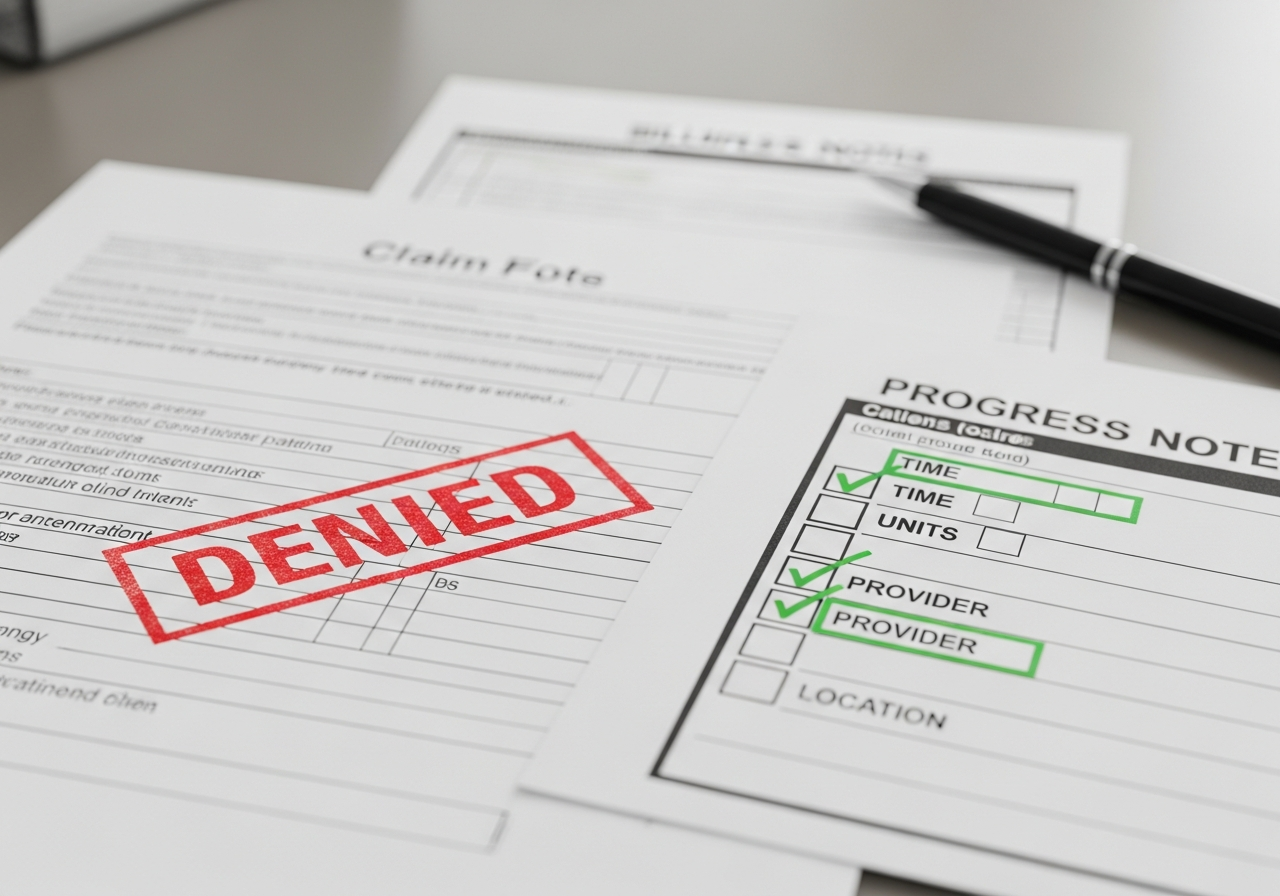
ABA claim denials are often blamed on the payer, but many rejections start inside the clinic. Not because the care was wrong, but because the record does not prove the care in the exact way the payer expects.
When documentation is missing a small detail, a payer’s system can label the claim as unpayable. Then you lose time, you rework notes, you resend, and you wait again. Over time, that drains energy from the team and creates revenue gaps that have nothing to do with clinical quality.
The good news is that most denial patterns repeat. Once you know the usual triggers, you can fix them with simple documentation habits.
Key Reasons ABA Claims Are Rejected Despite Completed Treatment
Payers usually reject a claim for one of four reasons:
- The service was not clearly tied to an active authorization
- The note does not match the code billed
- The time and units do not add up
- The provider details do not match payer rules
A denial does not always mean the service was not covered. Many times it means the payer cannot confirm coverage from the paperwork they received.
Make Every Note Match the Authorization
A lot of rejections happen because the authorization exists, but your note does not line up with it.
Common mismatch examples
- Authorization is for home sessions, note says clinic or doesn’t state location
- Authorization is active, but the date of service is outside the approved range
- Authorization is for one code, but the claim uses another code
- Units billed exceed the remaining units on the approval
Documentation fixes that work
- Put service locationin every note, using the same wording your authorization uses
- Add a small field in the note template called Authorized service type, so staff select the right category
- Track units usedweekly, not only when a denial hits
- If a session changes location or format, document the change clearly that day
Many teams notice that ABA therapy billing services are helpful mainly because they force these alignment checks before claims go out, which prevents avoidable rejections. This is not about promotion. It is about reducing preventable admin loops.
Time Must Be Clean, Simple, and Consistent
Time based problems are easy for payer systems to flag. One mismatch between what the note says and what the claim reports can trigger an automatic denial.
Common time mistakes
- Start time missing
- End time missing
- Total minutes not stated
- Two services overlapping for the same client
- Units billed do not match the documented minutes
Documentation fixes that work
- Always document start time, end time, and total minutes
- Use one standard format (example: 3:00 PM to 4:30 PM, total 90 minutes)
- Never allow two notes for the same client to overlap in time
- If the client left early or there was a long break, state it clearly
A strong note makes it obvious how the billed units were calculated. The payer should not have to guess.
Prove the Code With the Content of the Note
This is where many clinics lose revenue. The service happened, but the note reads like a general story, not like proof for a specific code.
What payers look for
They want to see that the work done fits the definition of the billed service.
Practical documentation fixes
Use a short code proof structure in every note:
- What goal or target was addressed
- What method was used (prompting, reinforcement, shaping, error correction)
- How the client responded (what changed, what was observed)
- A brief data summary (even one line)
You do not need long notes. You need notes that show clear evidence.
Make Goals and Notes Point to the Same Plan
Another denial trigger is when the payer asks for records and sees that the note targets do not match the treatment plan.
Common plan to note gaps
- Treatment plan updated, staff still writing to old goals
- Goals are written one way in the plan and another way in session notes
- Notes claim goals were worked on, but don’t identify them.
Documentation fixes that work
- Use the same goal names in the plan and the note
- Add a field called Goal addressedwith a dropdown or list
- When the plan changes, update templates and staff reminders the same day
The cleaner the link between plan and session, the less room for denial.
Avoid Copy Paste Patterns That Trigger Reviews
Repeated text is a silent risk. Even if the work is real, identical notes can look suspicious to a payer or auditor.
What copy paste can cause
- Requests for records
- Delays due to manual review
- Denials for insufficient documentation because it looks generic
Documentation fixes that work
Keep your format stable, but include at least one session specific detail each time:
- A change in prompt level
- A new barrier observed
- A different reinforcer used
- A behavior spike or drop
- A generalization attempt in a new setting
One real detail per note makes the record feel honest and specific.
Provider Details Must Be Correct Every Time
Claims can be denied if the payer sees a mismatch between the rendering provider and the documented provider.
Common provider related errors
- Wrong rendering provider selected in the billing system
- Credentials missing in the note signature
- Provider type does not match payer expectations for that code
Documentation fixes that work
- Ensure every note has a signature and credentials
- Confirm the rendering providerin billing matches the note author
- Keep a payer specific guide for provider rules (simple internal sheet)
This is not a clinical issue. It is a compliance and matching issue.
Location and Telehealth Details Must Be Stated Clearly
Even when telehealth is allowed, documentation must show it correctly.
Documentation fixes for telehealth
Include:
- Format used (video)
- Where the client was located
- Who was present
- Any limitations (connection issues)
Documentation fixes for in person sessions
- Specify the location clearly (home, clinic, community)
- Keep location wording consistent across schedule, note, and claim
A payer cannot validate what is not stated.Once you correct notes after a denial, you should also fix the root cause so it does not repeat. ABA billing services can become a practical checkpoint in the middle of the process, catching mismatches between authorization, notes, and claim data before submission. The value is simple: fewer preventable denials and less rework.
FAQs
1) What is the fastest documentation change that reduces ABA denials?
Add start time, end time, total minutes, and location to every note. These are frequent denial triggers and easy to standardize.
2) Do longer notes help prevent payer rejections?
Not necessarily. A short note with the right proof points is stronger than a long note that misses key details.
3) Why do claims deny even when the authorization is active?
Because the note, claim, and authorization may not match on code, dates, location, or units. The payer system often denies when it cannot confirm a match.
4) How do we avoid copy-paste problems without making notes hard to write?
Keep the structure the same, but include one session specific detail and a brief data snapshot. That creates natural variation.
5) What should a note include to support medical needs?
A clear link between the target and daily functioning, plus objective facts: what was addressed, what method was used, what the client did, and what the data suggests.
Conclusion
ABA claim denials drop when documentation becomes steady and consistent. You do not need complicated language or long explanations. You need clear proof that matches the authorization, supports the code, and makes time and provider details obvious. When notes, plans, and claims tell the same story, payers have less reason to reject. The work is already being done. Your job is to make the paperwork prove it.