



In the current era of digital saturation, the “Uncanny Valley” of text has become a significant hurdle for content creators. This phenomenon, originally used to describe the unease people feel toward robots that look almost—but not quite—human, now applies to prose. When a reader encounters a blog post that is logically sound but lacks rhythmic variation, emotional depth, or unique perspective, they subconsciously disengage. For businesses looking to scale their content without losing their brand’s soul, the use of a sophisticated ai detector is no longer just about policing; it is an essential quality-control tool used to identify and fix “robotic” patterns before they reach the public eye.
The Mechanics of Robotic Prose: Why AI Sounds “Off”
To humanize AI content effectively, we must first understand why machines write the way they do. Large Language Models (LLMs) are essentially advanced probability engines. They predict the next most likely word in a sequence based on massive datasets. This mathematical approach results in text with low “perplexity”—meaning it is highly predictable.
Human writing, by contrast, is messy. We use metaphors that shouldn’t work but do; we interrupt long, flowing descriptions with sharp, three-word sentences for emphasis; we draw on personal memories that a database cannot access. When an AI generates a draft, it tends to normalize these “irregularities,” creating a flat, monotonous experience. By running your drafts through a detection platform, you can visually identify which sections are too predictable, allowing you to target your editing efforts where they are needed most.
Injecting Information Gain and Unique Experience
The most effective way to humanize a machine-generated draft is through the concept of “Information Gain.” Google’s recent algorithm updates have placed a premium on content that adds something new to the internet’s collective knowledge. Since AI can only synthesize existing information, it cannot provide:
- Original Case Studies: Data from your own company’s experiments or client successes.
- Personal Anecdotes: The “human” stories behind the facts—the failures, the late-night realizations, and the specific office culture.
- Contrarian Views: Challenging the industry consensus. AI is programmed to find the “average” or “safe” answer, whereas humans can provide bold, disruptive insights.
By layering these elements onto an AI-structured draft, you transform a generic article into a high-value asset. You move from being a “content farm” to a “thought leader.”
The Stylistic Overhaul: Varying Your “Sentence DNA”
Linguistic “burstiness” is a key marker of human writing. This refers to the variation in sentence length and structure. A typical AI-generated paragraph often consists of 3-4 sentences of almost identical length. To fix this:
- The Power of the Short Sentence: Use them for impact.
- Rhetorical Questions: Engage the reader directly to break the one-way flow of information.
- Active Voice vs. Passive Voice: AI often defaults to a passive, academic tone. Converting this to active, punchy prose instantly makes the content feel more alive.
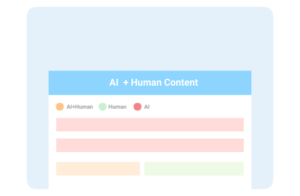
Using a verification tool allows you to see the “probability map” of your text. When you see a block of text highlighted as “highly likely AI,” your job as an editor is to break that pattern. Add an exclamation of surprise, a parenthetical aside (like this one), or a direct call to action.
Trust as a Competitive Advantage
As AI content floods the web, “Human-Made” is becoming a luxury brand. Consumers are developing a sixth sense for automated responses. When a brand takes the time to ensure its communication is genuinely human, it builds a reservoir of trust that competitors using “raw” AI cannot match.
This trust has a direct impact on conversion rates. A reader who feels they are being taught by a person is far more likely to subscribe to a newsletter or purchase a product than someone who feels they are being processed by an algorithm. Verification is the final step in your “Trust Stack.” It ensures that your brand’s voice remains authentic across all touchpoints, from social media to long-form white papers.
Future-Proofing for Search Engine Evolution
Google’s “Helpful Content System” is designed to reward content created for people, not for search engines. If your site is flagged as having a high percentage of unedited, automated content, your rankings are at risk of a sudden correction.
The goal for 2024 and beyond is to achieve a “Cyborg” workflow: use AI for the 80% of the work that is research and outlining, and devote your human energy to the 20% that provides the most value—the voice, the nuance, and the final verification. By integrating a professional ai content detector into your publishing pipeline, you are essentially performing an SEO audit on every sentence. You are ensuring that your content not only meets the technical requirements of an algorithm but also the emotional requirements of a human reader. This balance is the secret to sustainable growth in the age of automation.